Bitcoin faces slide to $60,000 if impending US shutdown triggers a statistical blackout
Bitcoin traders are aggressively positioning for a US government shutdown that could begin Jan. 31 if Congress fails to extend funding that expires Jan. 30.
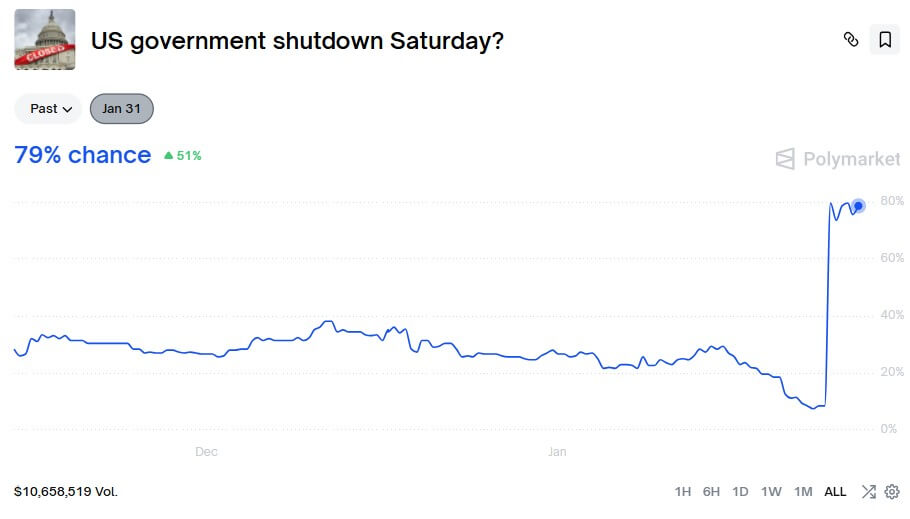
The urgency of the setup is visible in prediction markets, where odds changes have become tradable headlines in their own right.
Shutdown contracts on prediction platforms like Polymarket have swung to as high as 80% for a shutdown by Jan. 31. The market has drawn nearly $11 million in bets as of press time.
For BTC traders, these rapidly shifting probabilities translate into short-dated hedging demand and sharper moves around incremental legislative updates.
Notably, a partial shutdown tied to unfinished appropriations is the core risk under debate. The Wall Street Journal reports that this includes a contentious fight within the Department of Homeland Security in a broader $1.3 trillion spending package.
Consequently, the transmission to Bitcoin depends on whether the lapse disrupts core economic data releases and whether ETF outflows accelerate as managers cut risk.
Data fog is the headline risk, because rates set the tone for Bitcoin
A shutdown is not a debt-ceiling default event because Treasury interest and principal payments continue. However, the first-order shock of these events is often informational.
If a funding lapse pulls staff from agencies that publish market-moving releases, investors can lose scheduled anchors for inflation, jobs, and spending trends, forcing rate markets to trade with less clarity than they typically get from the macro calendar.
So, the risk is less about the government missing a payment and more about the market losing a timetable.
In prior shutdowns, officials warned that releases, including jobs and CPI, could be delayed, which is a straightforward problem for any market trying to price the path of monetary policy.
Bitcoin is not immune to that machinery. A large share of its macro sensitivity runs through real yields and liquidity expectations, which are often updated by official data points that sit at the center of the rate narrative.
Meanwhile, this setup also has sharper edges because the last shutdown was recent, and the market has fresh memory of what a prolonged disruption can do.
Indeed, the 2025 shutdown lasted 43 days and was the longest on record, a span long enough to turn delays into gaps.
As a result of this shutdown, Reuters reported that the October jobs and inflation reports might not be released, reflecting the risk that the data pipeline could be impaired rather than just paused.
Meanwhile, markets are not yet flashing a consensus panic signal into the Jan. 30 funding deadline. The Cboe Volatility Index was around 16.15 on Jan. 26, a level more consistent with contained equity stress than a broad rush into protection.
However, that does not prevent bitcoin from moving sharply around a headline window, because crypto volatility can reprice quickly when positioning shifts, especially when traders treat calendar risk as an event.
ETFs make shutdown risk actionable, and money markets shape the liquidity narrative
The mechanical channel that matters most for Bitcoin now sits in plain sight: ETF flows.
Spot bitcoin ETFs can translate macro unease into direct bitcoin selling through redemptions, even in the absence of a crypto-specific catalyst.
Data from SoSo Value showed roughly $1.33 billion of net outflows for the week ended Jan. 23. This places ETF flows at the center of any shutdown playbook, because managers cutting risk can express it quickly through their exposure.
That flow sensitivity is part of what makes a shutdown a rates-and-plumbing story, not just a Washington story.
If a lapse stalls economic releases and increases uncertainty about the policy path, risk budgets can tighten, and the first visible footprint in crypto can show up as ETF outflows.
Conversely, if the political noise fades quickly and flows stabilize, Bitcoin can trade more like a contained macro-risk asset rather than a crisis hedge.
Moreover, money-market optics also look different than during the period when the Federal Reserve’s overnight reverse repo facility held trillions of dollars.
Overnight RRP usage was about $1.489 billion as of Jan. 26, leaving little unused balance for traders to cite as a standing buffer in narratives about excess liquidity. A low balance does not mean the system lacks tools, but it changes the storytelling around resiliency, especially in a political deadline.
One counterweight is that backstops have been used without disorder. Reuters reported that last year saw record usage of the New York Fed’s standing repo facility at $74.6 billion, and the funding markets remained orderly.
This frames the tool’s use as a functioning backstop rather than a stress flare.
Meanwhile, a Federal Reserve speech published Jan. 16 reinforced that point in policy language. The speech described standing repo operations as intended to support monetary policy implementation and smooth market functioning, and it referenced their notable use around the 2025 year-end.
Gold is already wearing the hedge crown
For shutdown-risk pricing, the implication is not that liquidity is abundant, but that the toolkit exists and has been used when calendar effects press on short-term funding.
Demand for political-risk hedges is already showing up in traditional markets, which can dilute BTC’s ability to capture the first bid on shutdown headlines.
This week, gold’s price traded above $5,000 an ounce for the first time, and silver rose above $110 an ounce, both at record levels, setting a hurdle for BTC to outperform as an anti-fiat hedge during a headline-driven week.
When metals lead, Bitcoin often needs a reinforcing catalyst to join the same trade, and in this setup, that catalyst is more likely to be a rates narrative that turns supportive, or ETF flows that stop leaning against the tape.
How will this impact Bitcoin?
With that map, traders can translate shutdown length into a range of bitcoin regimes rather than a single directional call.
A short lapse that is patched within days (1 to 3 days) involves limited data disruption, where deal headlines dominate. Clean tells would include falling prediction-market odds, slowing ETF outflows, and funding normalizing. Ideally, the BTC regime could see a range of -3% to +6% over one week.
A longer lapse of 1 to 3 weeks changes the calculus. Visible delays raise a “data fog” premium and rates swing. Clean tells here would be agency delay notices, near-dated hedging staying bid, and metals holding gains. In this environment, Bitcoin’s price could range from -8% to +10% over two to three weeks.
However, a multi-week repeat of 2025-style disruption (more than 3 to 4 weeks) raises the odds that Bitcoin trades like a high-beta risk asset.
Sharp reversals are possible around deal headlines and rate repricing. Policy uncertainty would persist, and cross-asset volatility would rise.
Clean tells would include persistent ETF redemptions, tighter funding, and reports of missing or unreleased data.
The Bitcoin regime could face a drawdown window of 15% to 30%, which would drag prices from the current $87,780 level down to as low as around $60,000.
| Shutdown length | Market transmission | BTC regime, range framing | Clean tells |
|---|---|---|---|
| 1–3 days | Limited data disruption, deal headlines dominate | -3% to +6% over 1 week | Prediction-market odds fall, ETF outflows slow, funding normalizes |
| 1–3 weeks | Visible delays raise “data fog” premium, rates swing | -8% to +10% over 2–3 weeks | Agency delay notices, near-dated hedging stays bid, metals hold gains |
| More than 3–4 weeks | Policy uncertainty persists, cross-asset volatility rises | -15% to -30% drawdown window | Persistent ETF redemptions, tighter funding, reports of missing or unreleased data |
The post Bitcoin faces slide to $60,000 if impending US shutdown triggers a statistical blackout appeared first on CryptoSlate.